The Institutional Drivers of Global Prosperity
Economics American Economic Association, Economics, Global, Grand Canyon University, Management, Master's in Business Administration, MBAWhy are some countries rich while others remain trapped in poverty? Economists James A. Robinson, Daron Acemoglu, and Simon Johnson, co-recipients of the 2025 Nobel Prize in Economics, offer one of the most compelling answers: the institutional drivers of global prosperity.
Across three landmark Nobel lectures, the trio reaffirms their central thesis—developed over two decades of collaborative research—that the fate of nations hinges not merely on geography, culture, or natural resources, but on the political and economic institutions that shape incentives, distribute power, and allocate opportunity. These lectures update and deepen the arguments of their earlier works, such as Why Nations Fail and The Narrow Corridor, while addressing new challenges in the age of artificial intelligence and institutional disruption.
Table of Contents
ToggleInstitutional Drivers of Global Prosperity: The Core Thesis
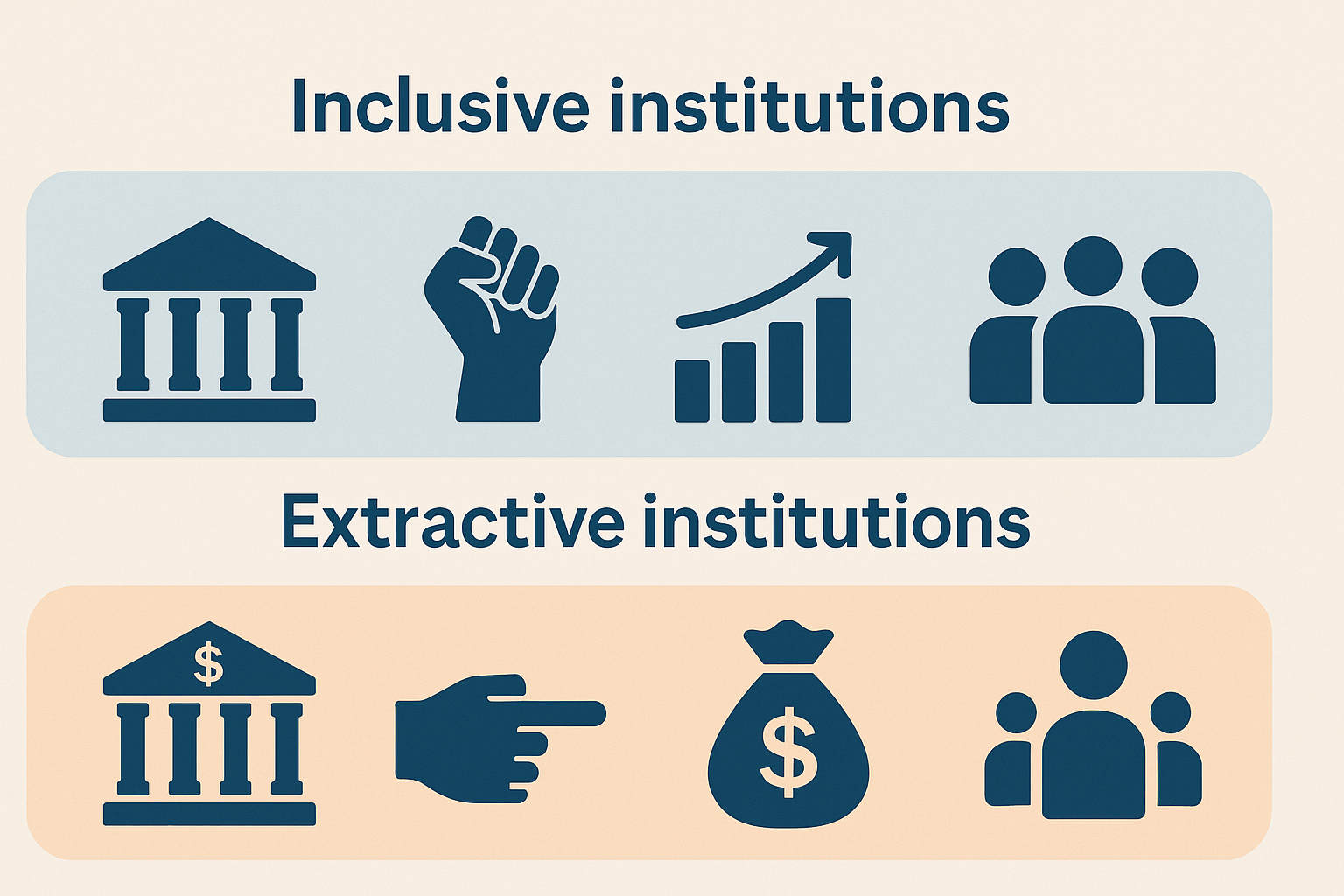
At the heart of their collective research lies a simple but profound insight: inclusive institutions lead to shared prosperity, while extractive institutions generate inequality, stagnation, and often collapse. Inclusive institutions are those that uphold the rule of law, protect private property, enable broad political participation, and foster innovation. In contrast, extractive institutions concentrate power and wealth in the hands of elites, limiting access to opportunity and discouraging growth.
In his lecture, James A. Robinson highlights a pivotal distinction between two sources of extractive institutions: power relations and normative orders. Power relations explain why elites often resist inclusive reforms—they simply have too much to lose. But normative orders—the shared beliefs and values within a society—can also justify or perpetuate extractive practices. Robinson contrasts the Confucian tradition in China, which values filial loyalty over rule-of-law ideals, with the corrupt land appropriation practices in peripheral Colombia, where even the elite undermine legal institutions without any ideological justification.
This dual framework helps explain why reforming extractive institutions is so complex. It’s not only about redistributing power—it’s also about transforming deeply held norms and expectations.
The Colonial Legacy: Settler Mortality and Institutional Paths
Simon Johnson revisits one of the most well-known findings from their joint research: how settler mortality during the colonial era created persistent institutional divergence. In regions where European settlers faced high mortality (such as West Africa or the Caribbean), colonial powers avoided mass settlement and built extractive institutions focused on resource extraction and elite control. In contrast, areas with low settler mortality (like the U.S., Canada, and Australia) developed more inclusive institutions, as settlers demanded property rights and legal protections for themselves.
These historical institutions persisted long after colonialism ended. Johnson’s lecture includes updated data showing that GDP per capita in the 2020s remains strongly correlated with historical settler mortality through its impact on institutions. Countries with extractive colonial institutions remain among the poorest, while those with inclusive legacies enjoy sustained growth.
The empirical evidence is robust. Even controlling for geography and human capital, Johnson shows that institutional quality is the best predictor of long-run prosperity. This underscores the enduring impact of historical choices on present-day economic outcomes—one of the strongest validations of the institutional drivers of global prosperity.
Institutions and Technology: A New Frontier
Daron Acemoglu’s lecture expands the institutional framework into the future by integrating it with technological change. His focus is on how institutions shape not just prosperity, but also the direction and diffusion of technology. Acemoglu introduces a conceptual tool—the Utility-Technology Possibility Frontier—to analyze how different institutional arrangements influence which groups benefit from innovation.
In inclusive systems, technology can raise overall prosperity while distributing gains broadly. But in extractive systems, elites often shape innovation to protect their dominance—even if it reduces overall growth. For example, automation may be favored not because it’s more productive, but because it concentrates power in fewer hands.
Acemoglu warns that artificial intelligence could follow this same path. Without inclusive institutions to ensure equitable access, AI might amplify inequality and disempower large segments of the population. He draws parallels between the industrial revolution and today’s AI wave, suggesting that our current “critical juncture” demands active institutional reform—just as Britain transformed its governance during the Glorious Revolution to unleash broad-based growth.
Trade-Offs, Norms, and the Path Forward
Robinson adds another layer by examining trade-offs between productivity and tradition. In many societies, institutions that seem inefficient—like communal land ownership in rural Ghana or lineage-based governance in Somalia—actually serve social functions like mutual insurance or conflict resolution. Reforming these systems isn’t just a matter of efficiency; it requires understanding the social order they uphold.
This recognition leads to a key insight: societies can change, but only by reconfiguring both power structures and normative orders. Botswana and Britain, for example, achieved inclusive growth not simply by adopting Western models, but by building institutions aligned with their cultural and political contexts.
Institutional Drivers of Global Prosperity: Why This Matters Today
The institutional drivers of global prosperity are more relevant than ever. In an era of rising authoritarianism, economic inequality, and technological upheaval, understanding how institutions shape outcomes is essential for policy, business, and civil society.
The Nobel lectures provide a roadmap:
For developing countries, the focus should be on building inclusive institutions that support property rights, independent courts, and democratic accountability.
For wealthy nations, the challenge is to ensure that innovation benefits the many, not just the few. This means regulating monopolies, protecting workers, and investing in public goods.
For the global community, institutions must evolve to manage common challenges—like climate change, pandemics, and digital governance—where the incentives of nation-states may diverge from shared prosperity.
Conclusion
The research of Robinson, Acemoglu, and Johnson offers one of the most powerful explanations for why some nations thrive and others struggle. Their work reveals that prosperity is not the result of fate or geography but of human decisions—particularly institutional design. If we want a more equitable and prosperous world, we must focus not just on economic growth, but on who builds the rules and who benefits from them.
The key to shared success lies in understanding—and reforming—the institutional drivers of global prosperity.
Acemoglu, Daron. 2025. “Nobel Lecture: Institutions, Technology, and Prosperity.” American Economic Review 115 (6): 1709–48.
Johnson, Simon. 2025. “Nobel Lecture: The Institutional Origins of Shared Prosperity.” American Economic Review 115 (6): 1749–86.
Robinson, James A. 2025. “Nobel Lecture: Paths to the Periphery.” American Economic Review 115 (6): 1787–1817.DOI: 10.1257/aer.115.6.1787