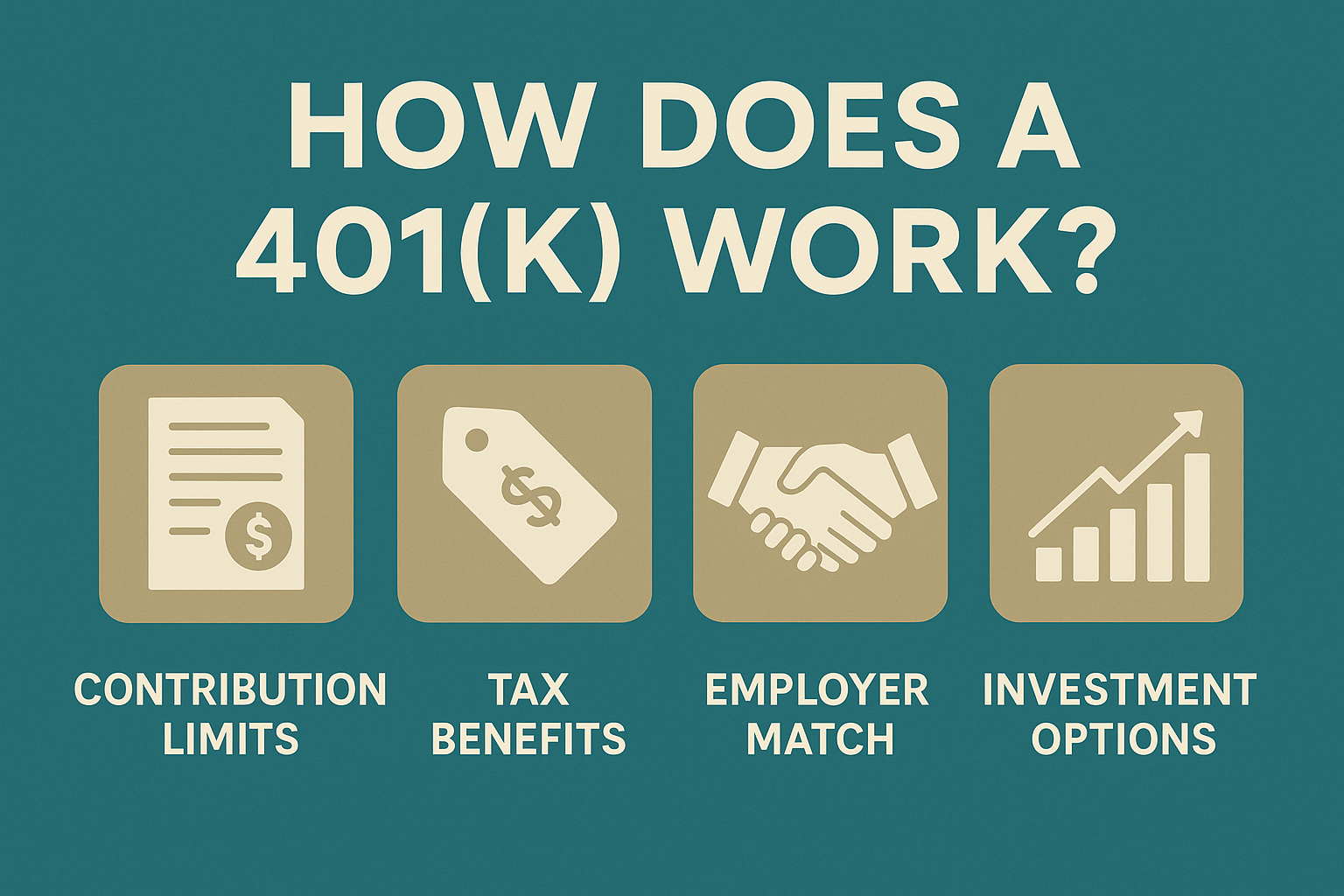
How Does A 401K Work
Personal Finance 401(k), Finance, investing, personal finance, SavingsHow does a 401k work, while first off it’s a defined-contribution retirement savings account your employer offers. Named after a section of the tax code, it lets you set aside a portion of each paycheck (often pre-tax) into your own retirement fund. Those contributions can be invested in mutual funds or similar assets that you choose. Many employers sweeten the deal by matching some of what you save – essentially giving you extra free money toward retirement.
Table of Contents
ToggleHow does a 401k work?
With a traditional 401(k), your contributions come out of each paycheck before taxes, which lowers your taxable income today. The money then grows tax-deferred until retirement, when withdrawals are taxed as ordinary income. In contrast, with a Roth 401(k) you contribute after-tax dollars, so there’s no tax break up front but qualified withdrawals in retirement are tax-free.
Once money is in your 401(k), you choose how to invest it. Most plans let you pick from a menu of mutual funds (for example stock and bond funds or “target-date” funds that automatically adjust as you near retirement). Note that withdrawals before age 59½ generally incur a 10% penalty and income tax (unless a rare exception applies). In other words, your 401(k) savings are meant for long-term retirement – it isn’t meant to cover emergencies or short-term needs.
Benefits of contributing to a 401(k)
-
Automatic saving: Contributions are deducted right from your paycheck, so you save before you can spend. This “pay yourself first” approach makes saving effortless.
-
Employer match (“free money”): Many companies match a portion of your contributions. For example, a common match is 50¢ for each $1 you save, up to a certain percentage of your salary. Meeting the match is a big win – it’s extra retirement money you’d otherwise leave on the table.
-
Tax advantages: With a traditional 401(k), every dollar you contribute reduces your current taxable income, which can lower your tax bill this year. (Your withdrawals in retirement are taxed later.) Or, if you choose a Roth 401(k), you pay tax now and then enjoy tax-free withdrawals later. Either way, your 401(k) balance grows tax-free as long as it stays in the account, which can make a big difference over time.
-
High savings limits: You can save much more in a 401(k) than in a regular savings account. For 2025, the IRS lets most workers defer up to $23,500 into their 401(k). Workers age 50+ can add another $7,500 “catch-up” contribution (for up to $31,000 total). These high limits let you build retirement savings faster.
-
Compound growth: Money in your 401(k) can earn returns (dividends, interest, etc.) that are reinvested. The earlier you start, the more time your balance has to grow through compounding. In effect, you earn “interest on interest,” which can dramatically boost your savings over decades.
-
Professional management: 401(k) funds are managed by professionals and typically include diversified options. Many plans offer target-date funds or balanced funds that automatically adjust the mix of stocks and bonds as you age, so you don’t have to pick individual investments if you’d rather keep it simple.
How does a 401k work: Drawbacks or limitations
-
Limited investment choices (and fees): You can only invest in the funds your plan offers. The average 401(k) plan has around 18 choices, which is far fewer than a brokerage account. Also, be aware that each fund has fees (expense ratios), and the plan itself may charge administrative fees that can eat into your returns.
-
Early withdrawal penalty: Your money is generally locked up until retirement. If you take it out before age 59½, you typically face a 10% IRS penalty plus ordinary income tax on the withdrawal. (There are very limited exceptions, but those can be complex.) In practice, this means you shouldn’t count on a 401(k) as an emergency fund; you should have other savings for short-term needs.
-
Required distributions: The government eventually forces you to withdraw from a 401(k). Starting at age 73, you must take out a minimum amount each year (the IRS calls these required minimum distributions) and pay taxes on them. This could be a drawback if you’d prefer to keep saving tax-deferred past that age.
2025 contribution limits
For 2025, the IRS contribution limits are: an employee deferral limit of $23,500. In addition, savers aged 50 or over can make a “catch-up” contribution of $7,500, bringing their total limit to $31,000. Under a recent law change, workers aged 60–63 qualify for a higher catch-up limit of $11,250 for 2025. (Your overall contributions – including any employer match – are subject to other limits, but the above numbers are the key employee/contribution caps.)
How does a 401k work: Tips for getting started
-
Start saving right away. If your employer offers a 401(k), enroll as soon as you’re eligible. Many companies auto-enroll new hires, so you might already be in the plan. If not, talk to HR about signing up. Even contributing a small percentage of your pay (1–5%) is better than zero.
-
Capture the full match. At a minimum, contribute enough to earn 100% of your employer’s match. For example, if your company matches up to 5% of your salary, save at least 5%. Fidelity and other experts say always grab the full match amount. It’s essentially free money.
-
Keep it simple with a diversified fund. If you’re not comfortable picking funds, consider a target-date or balanced fund that automatically adjusts as you get closer to retirement. That way, you get a mix of stocks and bonds without having to manage it yourself.
-
Increase contributions over time. Set up any available auto-escalation feature (many plans let you automatically raise your rate by 1% each year). Or plan to boost your contribution whenever you get a raise. A gradual increase can significantly grow your balance over the long run.
-
Don’t ignore fees or fund choices. Review your plan’s investment fees and pick the lowest-cost funds you’re comfortable with. High fees can cut into your returns over decades, so favor index funds or low-fee target-date funds when possible.
-
Maintain an emergency fund. Because 401(k) savings are hard to access early, keep some cash savings or a liquid account for real emergencies. That way you won’t be tempted to withdraw from or borrow against your 401(k) and incur penalties.